

In 2026, UK homes typically aren’t selling for one of ten reasons: an unrealistic asking price, weak online presentation, the wrong estate agent, lacklustre kerb appeal, tired interiors, visible disrepair, survey issues, chain risk, wrong listing time, or a slower local market. Of these, around half can be addressed by good preparation work — including the kind of remedial building work many sellers overlook until a survey forces it.
This guide covers each of the 10 reasons in turn, with current 2026 UK and Oxford market data, and a clear marker against each one showing whether it’s something a builder can credibly help with — or whether it sits outside their remit.
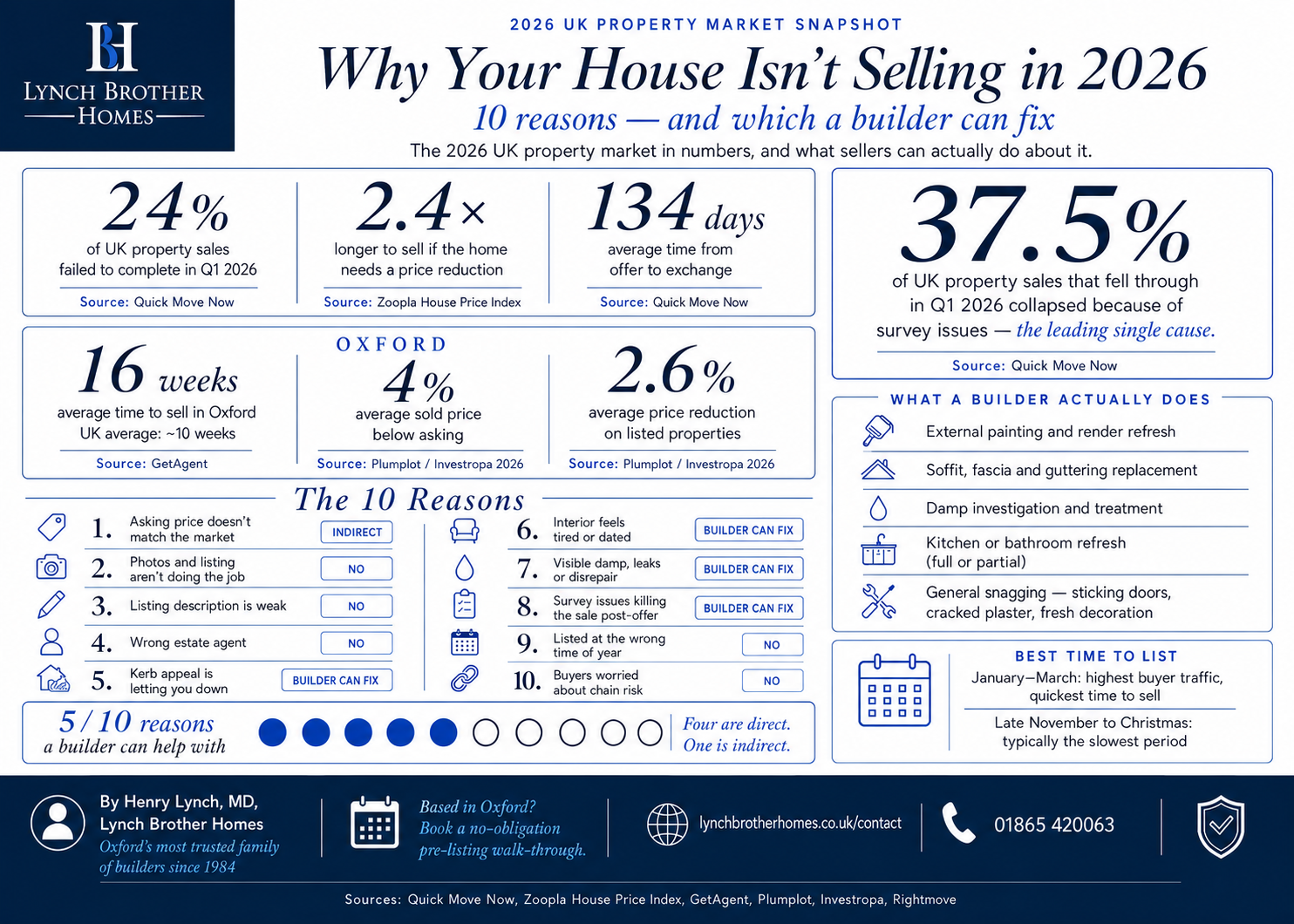
The 2026 UK property market: what sellers are actually facing
The current market is genuinely tougher than it has been in over a decade. Three statistics tell the story:
- 24% of UK property sales failed to complete in Q1 2026 (Quick Move Now)
- Homes that need a price reduction take 2.4x longer to sell than those priced right from the start (Zoopla House Price Index)
- The average time from offer to exchange has risen to 134 days, up significantly from previous years
For Oxford specifically, the picture is harder still. Properties take an average of 16 weeks to sell against a UK average of around 10 weeks (GetAgent). Sold prices average 4% below asking, with average reductions of 2.6% on listed prices (Plumplot, Investropa 2026 data). This isn’t 2021, when properties sold themselves — buyers in 2026 have choice, time, and the leverage that comes with both.
That’s the context for everything that follows.
1. Your asking price doesn’t match the current market
The single biggest factor in slow sales. If your home is priced 5–10% above what comparable properties have actually sold for, you’re not in the market — you’re parked next to it.
Why it stops sales: Buyers in 2026 are price-sensitive and well-informed. Rightmove and Zoopla make recent sold prices visible to anyone. An over-priced property gets filtered out of buyers’ searches at standard price-bracket boundaries, then dismissed by buyers who do see it as out of touch. Zoopla’s data shows homes that need a cut take 2.4x longer to sell than those priced right from the start.
What to do: Get three valuations, not one. Look at sold prices for similar properties on your street within the last six months — not asking prices. Price for the market that exists today, not the one you bought in. A property priced right from launch attracts competition; one that needs a cut after eight weeks signals “problem property” and rarely recovers full value.
2. Your photos and listing aren’t doing the job
Effectively all UK property buyers start their search online. Rightmove handles over 80% of UK listings. Your photos are either attracting viewings — or losing them.
Why it stops sales: Buyers spend seconds on each thumbnail. Dark, badly composed, or low-resolution photos get scrolled past. Listings without floor plans, virtual tours, or video content lose interest from buyers who want to triage from their sofa before booking a viewing.
What to do: Insist on professional photography — most agents include this but quality varies enormously. Ask to approve photos before they go live. Consider a video tour or 360° virtual tour, particularly for higher-value properties. Declutter and stage every room before the photographer arrives, not afterwards.
3. The listing description is weak
Often overlooked. The estate agent’s text accompanying the photos either sells the property or treats it as a list of room dimensions.
Why it stops sales: Generic descriptions don’t differentiate from the dozens of other listings the buyer is comparing. They also miss buyer-relevant information that drives decision-making — school catchments, commute times, recent improvements with warranties, garden orientation.
What to do: Read your listing as a buyer. Does it answer “why this property over the others?” If not, push the agent for a rewrite. Highlight what’s specific to your home — the south-facing garden, the new boiler with a 10-year warranty, walking distance to a desirable school, the recent loft conversion with sign-off certificates. Specificity sells.
4. You’ve chosen the wrong estate agent
Estate agent performance varies widely, and the difference matters more in a buyer’s market than in a seller’s.
Why it stops sales: A weak agent under-prices, under-markets, doesn’t follow up viewings, fails to negotiate, and lets enquiries go cold. In Oxford specifically, local network and an active database matter as much as Rightmove visibility — a strong local agent has buyers waiting before the listing goes live.
What to do: Use estate agent comparison tools (GetAgent, EstateAgent4Me) to check sold-price-vs-asking ratios and average days on market. Ask shortlisted agents how many properties they’ve sold in your postcode in the last six months — not just how many they’ve listed. Switch agents if your current one is delivering nothing after eight weeks; a fresh listing with a fresh agent often outperforms a stale relisting.
5. Your kerb appeal is letting you down (A builder can help)
Buyers form their first impression within seconds of arriving. If the exterior of your property looks tired, neglected, or mid-maintenance, that impression carries through every room of the viewing.
Why it stops sales: A peeling front door, cracked render, broken guttering, rotting soffits and fascias, or a moss-covered driveway all signal “more work than I want to take on” — and that calculation happens before the buyer steps inside. Even if the interior is immaculate, the buyer has already started discounting.
What to do: Walk to the end of your driveway and look back at the property as a stranger would. Address the obvious. External painting, render repair, replacement of any rotting timber, fresh guttering, and a clean drive are usually achievable in two to three weeks of focused work. Our guide on when to replace soffits and fascias covers one of the most common kerb-appeal killers.
6. The interior feels tired or dated (A builder can help)
Worn kitchens, dated bathrooms, scuffed walls and tired décor all signal “renovation budget needed” to a buyer — and they reduce their offer accordingly.
Why it stops sales: Buyers in 2026 calculate the cost of bringing a tired property up to standard and subtract it (with a generous margin) from what they’re willing to offer. A £10,000 cosmetic refresh can easily protect £25,000–£40,000 of asking price on a typical Oxford property.
What to do: Identify the high-impact areas — usually kitchens, bathrooms, and main reception rooms. Full renovation isn’t always necessary; a focused refresh (paint, fixtures, worktops, taps, lighting) often delivers the same buyer perception at a fraction of the cost. Our guides on house renovation in Oxford and what adds the most value to a house go into more detail.
7. Visible damp, leaks or signs of disrepair (A builder can help)
This is different from “tired”. Tired is cosmetic. Damp patches, water staining, sticking doors, cracked walls, and signs of subsidence are structural concerns — and buyers either walk away or use them as significant negotiation leverage.
Why it stops sales: Buyers don’t know whether visible damp is cosmetic or symptomatic of a £15,000 problem. The default assumption is the worse one. Even if the underlying issue is minor, the visible signal triggers either a withdrawn offer or a heavy discount.
What to do: Get visible issues investigated and addressed before listing. A damp specialist’s assessment and treatment is far less costly than the discount a buyer will demand at offer stage. Our article on spotting the early signs of damp covers what to look for room by room.
8. Survey issues are killing your sale after offer (A builder can help)
This is the single biggest 2026 story for sellers. Quick Move Now data shows that 37.5% of all UK property sales that fell through in Q1 2026 collapsed because of survey issues — by far the leading cause.
Why it stops sales: Buyers’ surveyors are under more pressure than ever to flag risk in a flat-price market. Lenders are less willing to overlook issues. The result: sales that would have completed three years ago now collapse or get aggressively renegotiated at survey stage.
What to do: Pre-listing remedial work pays for itself. Common survey killers — damp, roof issues, electrical or heating systems past their useful life, structural movement, dated wiring — are all addressable before listing. The cost of fixing them upfront is almost always less than the discount a buyer will demand or the months of relisting if the sale falls through. A pre-listing survey (£400–£800) can identify what to address.
9. You listed at the wrong time of year
Seasonality matters more than most sellers realise.
Why it stops sales: Rightmove’s 2026 data shows that the first working week of January now generates the highest buyer traffic of the entire year, with January, February, and March producing the quickest average time to sell. Late November through Christmas is the deadest period — buyers are distracted, family-focused, or waiting for the new year.
What to do: If you have flexibility on timing, list in January–March. If you’re listing outside that window, lean harder on every other factor — pricing, presentation, agent quality — to compensate for thinner buyer demand. A property that lists in October needs to be near-perfect to perform; one that lists in February has more room for slight imperfection.
10. Buyers are worried about chain risk and completion certainty
The 2026 market is full of cautious buyers and slow chains. Sellers who appear committed and chain-free or short-chain have a meaningful advantage.
Why it stops sales: With 24% of UK sales falling through in Q1 2026 and average exchange now taking 134 days, buyers are increasingly unwilling to commit to long chains or sellers whose onward purchase looks uncertain. Many will simply choose a chain-free alternative even at slightly higher cost.
What to do: Be ready to move. Have your onward purchase secured or temporary accommodation planned before listing. Be transparent with viewers about your chain status from the outset. Respond to enquiries, surveys, and conveyancing requests within 24 hours — speed signals seriousness and reduces the window in which a buyer can lose interest.
What a builder can actually do for you
Of the 10 reasons above, five sit within a builder’s remit: kerb appeal (#5), tired interiors (#6), visible disrepair (#7), survey issues (#8), and indirectly the asking price (#1) — because addressing the others can mean justifying the price you originally hoped for.
Often the difference between a home that sits and one that sells is two to four weeks of focused remedial work before listing. The most common pre-sale jobs we see:
- External painting and render refresh
- Soffit, fascia and guttering replacement
- Damp investigation and treatment
- Kitchen or bathroom refresh — full or partial
- General snagging — sticking doors, cracked plaster, dated fixtures, fresh decoration throughout
An honest caveat: not every issue is worth fixing before sale. Some properties are best sold “as-is” at a reduced price, particularly if the prospective buyer is likely to renovate to their own taste anyway. A good builder will tell you which jobs will repay themselves and which won’t — and that conversation should happen before any work is quoted.
If you’re in or around Oxford and not sure which side of that line your property sits on, get in touch for a no-obligation pre-listing walk-through. We’ll tell you honestly which work will protect your price and which is wasted money.
Frequently asked questions
How long should it take to sell a house in 2026?
The UK average is around 66 days from listing to sale agreed (Rightmove), though this varies hugely by region. Oxford properties currently take an average of 16 weeks to sell — slower than the national figure due to higher prices and increased buyer caution. After offer is accepted, expect another 134 days on average to exchange.
Should I renovate before selling, or sell as-is and reduce the price?
It depends on the work needed. Cosmetic refreshes (painting, simple kitchen and bathroom upgrades, addressing damp) almost always pay back more than they cost. Major structural work or full renovations rarely do — you’re better off pricing accordingly and letting the buyer renovate to their own taste. A good builder will give you an honest view of which side of the line each job sits.
What’s the minimum I should fix before listing?
At minimum: address anything visible at viewing (peeling paint, broken guttering, damp patches, sticking doors), and anything likely to flag on a survey (roof issues, electrical or heating systems past their useful life, signs of damp). Cosmetic improvements come second; structural and survey-relevant work comes first.
How much does a pre-listing survey cost and is it worth it?
A RICS Level 2 (HomeBuyer) survey costs £400–£800 for a typical UK home; a Level 3 (Building Survey) costs £600–£1,500. For older or higher-value properties, or if you suspect issues, the cost is almost always recovered through avoided post-offer renegotiation or fall-throughs.
Does new paint and decoration actually add value?
Yes — but the value is largely in protecting your asking price rather than increasing it. Fresh, neutral decoration helps buyers visualise themselves in the space and removes excuses to negotiate down. Most property valuation surveys consistently rank it as one of the highest-ROI pre-sale improvements.
What’s the difference between a fall-through and a re-list?
A fall-through is when an agreed sale collapses before exchange (in 2026, around 24% of UK agreed sales). A re-list is when a property is taken off the market and put back on, often with a new agent or revised price. A re-list after a fall-through carries some stigma — buyers see the price drop or change of agent and read it as a problem. Avoiding fall-throughs by doing pre-listing work is almost always cheaper than recovering from them.
